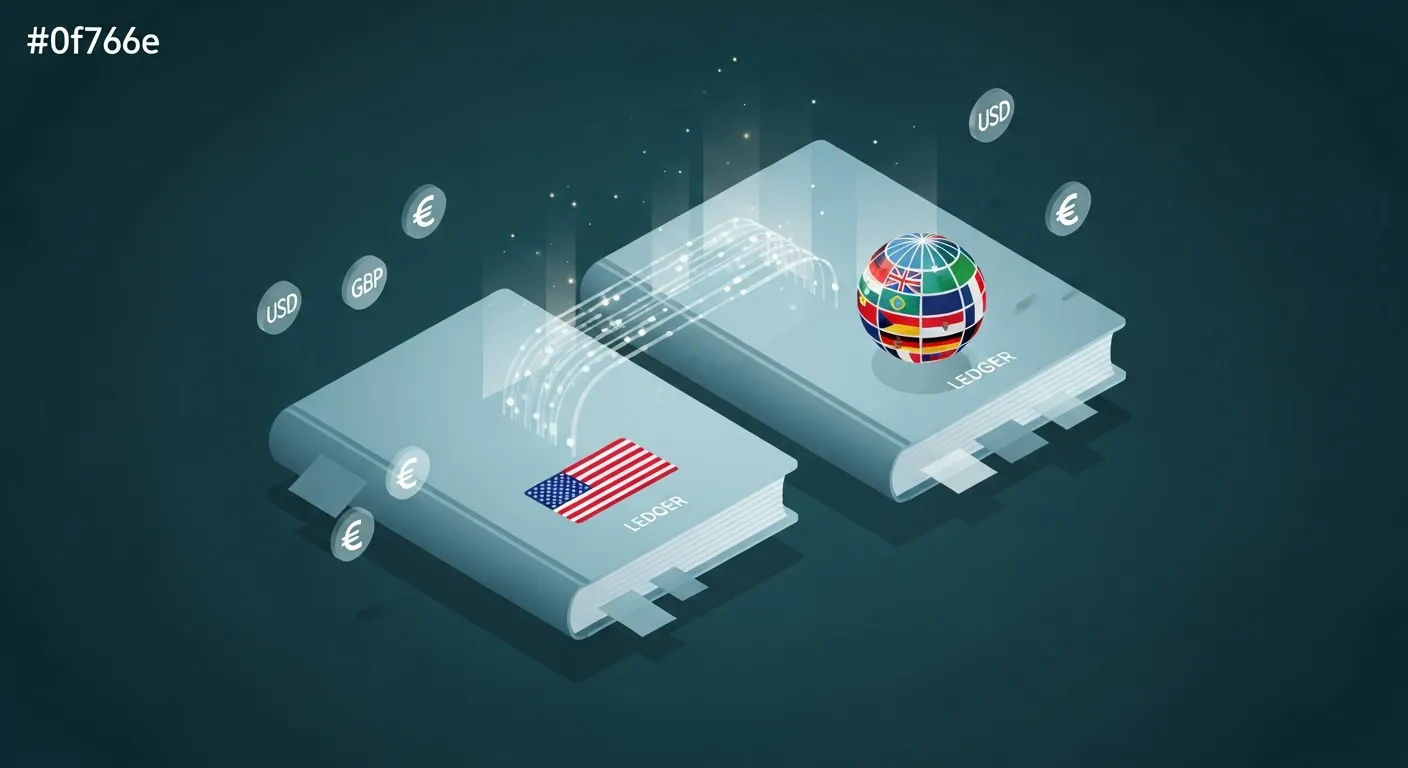
Cross-Border Bookkeeping: Why You Need Two Sets of Books
No single tool handles both US LLC and home-country tax compliance. Dual bookkeeping structure: US side (doola, Xero) + home side (FreeAgent, Zoho) by country.
Some links on this page go to partners who compensate us. This does not affect our analysis or rankings. How we make money
Quick take
A founder in Manchester operating a US LLC has two bookkeeping obligations. The US side requires USD-denominated records, Form 5472 documentation, and a pro-forma 1120 for the IRS. The UK side requires Self-Assessment reporting, Making Tax Digital compliance, and records in GBP for HMRC. Different standards, different currencies, different tax calendars, different software. One set of books cannot cover both.
This isn't a UK-specific problem. CRA treats the US LLC as a corporation even though the IRS treats it as a disregarded entity. Indian founders face FEMA compliance for overseas investments. German founders deal with Gewerbesteuer calculations that have no US equivalent.
Cross-border bookkeeping is two parallel problems that happen to involve the same money.
Related: doola vs Pilot vs DIY bookkeeping | Xero vs QuickBooks for international LLCs
Why one set of books is not enough
The mismatch between US and home-country obligations goes deeper than software. It is structural:
| Dimension | US LLC Books | Home-Country Books |
|---|---|---|
| Currency | USD (required) | Local currency (GBP, CAD, INR, EUR) |
| Accounting standard | US GAAP or tax-basis | Local GAAP (UK FRS, Indian AS, German HGB) |
| Tax year | Calendar year (Jan 1 - Dec 31) | Varies: UK (Apr 6 - Apr 5), India (Apr 1 - Mar 31), others calendar |
| Entity classification | Disregarded entity (single-member LLC) | Varies: UK/Canada/Germany may treat as corporation |
| Required filings | Form 5472, pro-forma 1120, state reports | Self-Assessment (UK), T1134 (Canada), ITR-3 (India), Einkommensteuer (Germany) |
| Professional credentials | US CPA | UK ACCA/ICAEW, Canadian CPA, Indian CA, German Steuerberater |
| Software ecosystem | Xero US, QuickBooks US, doola | FreeAgent (UK), Zoho Books (India), DATEV (Germany) |
Even when the same vendor operates in both countries, the editions are walled off. Xero US and Xero UK run as separate organizations with separate charts of accounts, separate tax configurations, and no cross-entity reconciliation. Payment processor choice adds another layer: if you use a Merchant of Record like Paddle, your US-side books receive net payouts rather than gross transactions — the Stripe vs Paddle vs Lemon Squeezy breakdown covers how each model affects bookkeeping.
I ran AirPop across the US and China for years with two completely separate accounting systems — USD for US tax, CNY for Chinese compliance. The same revenue appeared in both books at different amounts because transaction-date exchange rates never matched year-end reconciliation rates. I tried consolidating into one system once. It created more problems than it solved. Two books is less elegant, but it works.
The two sides of cross-border bookkeeping
Side 1: US LLC books
Most cross-border founders set up this side first, and for good reason. Form 5472 carries a $25,000 penalty for non-filing. You need USD-denominated records, Form 5472 documentation, and whatever your US CPA requires for the annual filing. Three paths:
| Service/Path | Annual Cost | Form 5472 | Multi-Currency | Non-Resident Support |
|---|---|---|---|---|
| doola Business-in-a-Box | $2,999/yr | Included | Proprietary platform | Core market |
| Pilot Essentials + Tax | $2,788+/yr | Separate ($500) | QuickBooks-based | Yes |
| DIY: Xero Established | $744/yr ($62/mo) + CPA ($500-2,500) | Separate CPA | 160+ currencies | Yes |
| DIY: QuickBooks Essentials | $600/yr ($50/mo) + CPA ($500-2,500) | Separate CPA | Yes (irreversible setting) | Yes |
For a detailed comparison, see doola vs Pilot vs DIY.
Side 2: Home-country books
No US-focused bookkeeping service handles this side. Not doola, not Pilot, not Bench. Home-country books track worldwide income (including US LLC profits) in local currency, using local accounting standards. You need a local accountant with country-specific tools.
Tools by country
| Country | Common Software | Why Not US Tools |
|---|---|---|
| UK | FreeAgent (free with NatWest/RBS), Xero UK, Sage UK | MTD-compliant filing, VAT, Self-Assessment, PAYE — none exist in US editions |
| Canada | QuickBooks CA, Sage CA, Wave (free, CA/US only) | GST/HST filing, T1134/T1135 prep — CA-specific tax forms |
| India | Zoho Books India edition, Tally, ClearTax | GST direct filing, FEMA documentation, Schedule FA/FSI — India-specific compliance |
| Germany | DATEV (via Steuerberater), Lexoffice, SevDesk | Gewerbesteuer, Umsatzsteuer (VAT), EUeR — German accounting standards, 10-year retention |
| Australia | Xero AU, MYOB | BAS/GST lodging, PAYG — Australian-specific compliance |
| Singapore | Xero SG, Zoho Books SG | IRAS filing, GST — SG-specific compliance |
Services by country
If you want managed bookkeeping on the home-country side (the equivalent of doola for the US):
| Service | Countries | What It Covers | Starting Price |
|---|---|---|---|
| Osome | UK, Singapore, Hong Kong | Full compliance: VAT, Self-Assessment (UK), Corporation Tax, annual filings. Dedicated accountant. | ~GBP 71/mo (UK) |
| Sleek | UK, Singapore, Hong Kong, Australia | Compliance + Xero subscription included. Corporate secretary + accounting. | ~GBP 60+/mo (UK) |
| Local accountant | Any country | Varies by jurisdiction. Typically handles personal tax returns + business income reporting. | Varies ($50-300/mo depending on country) |
Osome and Sleek handle the home-country side only. The US side still needs doola, Pilot, or a US CPA.
How does your structure score?
Free 2-minute screening across Money, Entity, Tax, and Accountability.
Country-specific bookkeeping requirements
UK: MTD + Self-Assessment
Starting April 2026, Making Tax Digital requires quarterly digital updates to HMRC. US LLC income gets reported as foreign income on Self-Assessment.
| Requirement | Details |
|---|---|
| Making Tax Digital (MTD) | Mandatory from April 2026 for self-employed with qualifying income above threshold. Quarterly digital updates via compatible software (FreeAgent, Xero UK, Sage UK, QuickBooks UK). |
| Self-Assessment | US LLC income reported as foreign income. Due by January 31 following the tax year (April 6 - April 5). |
| Entity classification | HMRC treats US LLCs as opaque entities (corporations), not pass-through. This creates timing and classification mismatches with US treatment. |
| Foreign Tax Credit | Available to avoid double taxation, but the entity classification mismatch complicates the credit calculation. |
| Fiscal year mismatch | UK tax year: April 6 - April 5. US tax year: January 1 - December 31. 3-month overlap creates reconciliation complexity. |
More on the UK entity classification trap in UK Ltd vs US LLC.
Canada: CRA entity mismatch
CRA treats US LLCs as corporations no matter what the IRS says. Without proper planning, this creates effective tax rates of 50-75%. Canadian founders face three additional filing requirements:
| Requirement | Details |
|---|---|
| T2125 (Business Income) | Reports business income on personal T1 return. US LLC income flows through here if treated as self-employment. |
| T1134 (Foreign Affiliate) | Required if the Canadian owns a "foreign affiliate" — which CRA considers a US LLC to be. Filing penalties apply. |
| T1135 (Foreign Income Verification) | Required if foreign property exceeds CAD $100,000 at any time during the year. The US LLC interest itself counts as specified foreign property. |
| Entity classification trap | CRA treats LLC as a corporation → LLC income is not pass-through for Canadian tax purposes → potential double taxation at 50-75% effective rate. |
| Foreign Tax Credit | Available but complicated by entity classification mismatch. Credit calculation differs from UK/US approach. |
More on this in Canada-US Tax Treaty and LLC Income.
India: FEMA + Schedule FA
FEMA violations carry penalties up to 3x the amount involved. Indian residents owning a US LLC have to clear FEMA/ODI compliance for the overseas investment, report foreign assets on Schedule FA, and deal with potential GST implications.
| Requirement | Details |
|---|---|
| FEMA/ODI compliance | Investing in a US LLC is an Overseas Direct Investment. Must be routed through an Authorized Dealer bank, filed via Form FC, reported annually to RBI. |
| ITR-3 with Schedule FA + FSI | Indian residents must report global income. US LLC profits taxable in India whether remitted or not. Schedule FA (Foreign Assets) and Schedule FSI (Foreign Source Income) are mandatory. |
| GST | Grey area for services provided from India via US LLC. Zero-rated export of services may apply. Professional CA guidance needed. |
| Penalty risk | FEMA violations: up to 3x the amount involved. Non-disclosure of foreign assets on ITR: INR 10 lakh penalty. |
| Software | Zoho Books (India edition with GST direct filing), Tally, ClearTax. Indian CA handles compliance. |
More on FEMA compliance in India Founder Forming US LLC.
Germany: Gewerbesteuer + EUeR
Germany taxes worldwide income at 14-45%, may add Gewerbesteuer (trade tax) on top, and requires 10-year document retention. The Finanzamt wants records in German accounting standards, not US GAAP.
| Requirement | Details |
|---|---|
| Einkommensteuer (Income Tax) | Progressive rates 14-45%. Germany taxes worldwide income of residents. US LLC income goes on personal tax return. |
| Gewerbesteuer (Trade Tax) | 3.5% base rate x local multiplier (e.g., Berlin ~14.35%). First EUR 24,500 exempt. Applies if the activity constitutes a Gewerbe (trade) vs Freiberuf (freelance profession). |
| Bookkeeping standard | EUeR (simplified income-surplus calculation) for smaller businesses. Full double-entry (Bilanzierung) above revenue thresholds. |
| Record retention | 10 years for invoices and financial documents. |
| Software | DATEV (dominant, used by most Steuerberater), Lexoffice, SevDesk. Germany-specific; not interoperable with US accounting tools. |
How the two sides connect
The connection point is the LLC profit distribution. The same money shows up in both sets of books — as LLC income on the US side, as foreign income on the home-country side — at different exchange rates and often in different tax periods.
| Step | US Books | Home-Country Books |
|---|---|---|
| 1. Revenue received | Recorded in USD at transaction date | Not yet recorded (stays in LLC) |
| 2. Expenses paid | Recorded in USD | Not yet recorded |
| 3. Profit calculated | Net income in USD | Not yet applicable |
| 4. Distribution to founder | Recorded as owner draw/distribution | Recorded as foreign income in local currency at distribution-date exchange rate |
| 5. Year-end | Form 5472 + pro-forma 1120 filed | Foreign income declared on annual tax return |
The exchange rate gap. US books record at the spot rate on the transaction date. Home-country books may use the distribution-date rate, a period average, or whatever the local tax authority mandates. The numbers will never match exactly. That is normal, but the gap must be documented. An unexplained difference between the two books is an audit risk.
The timing gap. If the US tax year is January-December and the UK tax year is April-April, a distribution in March lands in US tax year N but UK tax year N-1. Both accountants need to know this is happening.
Get structural patterns other founders miss
One blind spot, every two weeks. No spam.
Common mistakes
Mistake 1: Ignoring the home-country side entirely
This is the most common and most expensive mistake. A UK founder who files Form 5472 with the IRS but skips reporting US LLC income on Self-Assessment is not compliant in the UK. HMRC penalties for undeclared foreign income can reach 200% of the tax owed.
Mistake 2: Trying to use one system for both
A single Xero or QuickBooks account with multi-currency transactions does not satisfy dual-jurisdiction compliance. The US side needs USD records with US-standard categorization. The UK side needs GBP records that feed into MTD. Different charts of accounts, different tax codes, different reporting output.
Mistake 3: Using the same accountant for both sides
A US CPA cannot file UK Self-Assessment returns. A UK ACCA cannot prepare Form 5472. You need two professionals, and they need to talk to each other. The US CPA needs to know that HMRC treats the LLC as opaque. The UK accountant needs to know that the IRS treats it as disregarded. When they don't share this context, foreign tax credits get calculated wrong and you end up double-taxed.
I learned this the hard way with AirPop. My US accountant and my China accountant operated in silos for two years before I forced a joint call. The amount of duplicated and misclassified income they uncovered was embarrassing.
Mistake 4: Not documenting inter-entity transfers
Every transfer from the US LLC bank account to your personal home-country account is reportable on both sides. US side: owner distribution. Home-country side: foreign income receipt. If you don't record these consistently in both books, reconciliation breaks down and audit exposure goes up.
Key Takeaways
- Cross-border founders need two sets of books — one for the US LLC (in USD, for IRS compliance) and one for their home country (in local currency, for local tax authority compliance). No single tool or service handles both.
- US-side tools: doola ($2,999/yr all-in), Pilot ($349+/mo), or DIY with Xero/QuickBooks ($50-62/mo) plus a US CPA. See doola vs Pilot vs DIY for details.
- Home-country tools vary by jurisdiction: FreeAgent for UK (free with NatWest), Zoho Books for India (GST direct filing), DATEV/Lexoffice for Germany, QuickBooks CA for Canada. Managed services like Osome and Sleek cover UK/SG/HK compliance.
- The two books connect at the LLC profit distribution. Same money, different exchange rates, often different tax periods. Document the gap or it becomes an audit risk.
- You need two accountants: a US CPA for Form 5472 and IRS compliance, and a local professional (UK ACCA, Indian CA, German Steuerberater) for home-country filing. Make sure they talk to each other.
References
- IRS Form 5472 instructions — information return for 25% foreign-owned US corporations
- doola Total Compliance — US LLC bookkeeping and tax filing for non-residents
- Xero — multi-currency cloud accounting with 1,000+ integrations
- QuickBooks Online — US-standard accounting with CPA collaboration
- FreeAgent — UK-focused accounting with MTD and Self-Assessment support
- Zoho Books — India-focused accounting with direct GST filing
- Pilot — managed bookkeeping and tax for startups
Related Tools
Related Articles
Xero vs QuickBooks for International LLC Owners (2026)
Xero ($62/mo) vs QuickBooks ($50/mo) for non-resident LLC owners. Multi-currency, Mercury/Wise bank feeds, 1099 prep, and CPA access compared.
SBA Now Requires 100% Citizen Ownership for Loans -- What That Means for Cross-Border Founders
As of March 2026, SBA loans require 100% US citizen ownership. Green card holders, permanent residents, and mixed-citizenship businesses are now excluded. Here's what changed and why it matters structurally.
BEA-15: The Federal Survey Most LLC Owners Miss
Foreign-owned US LLCs may owe a BEA-15 filing to the Bureau of Economic Analysis. Who files, exemptions, deadlines, and how it differs from Form 5472.
BOI Filing: Do Non-Resident LLC Owners Need to File?
FinCEN's March 2025 rule exempted US-formed LLCs from BOI filing. Who is exempt, who still files, and what the transparency trend means.
What to Check After Filing Your US LLC Taxes: A Post-Filing Structural Review (2026)
You filed. You made the deadline. Here are the five structural checks most cross-border LLC founders skip in the 30-60 days after April 18 — and why filing compliance is not the same as structural correctness.
Summarize with AI

Cross-border entrepreneur running businesses across the US, China, and beyond for 20+ years. I built Global Solo to map the structural risks I wish someone had shown me.
Where does your structure have gaps?
Two free ways to map your cross-border risk — pick the depth that fits your time.
Structural Patterns
One blind spot, every two weeks. For entrepreneurs operating across borders.
Free LLC Formation Checklist included